Call for Papers: Language Accessibility, Equity, and Translation Technologies for Medicine and Public Health
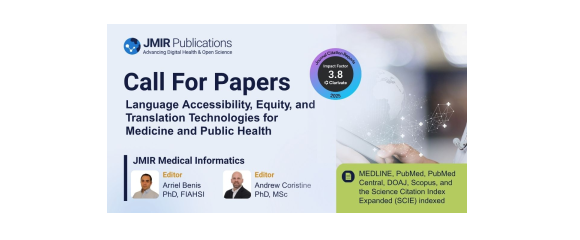
As health care systems become increasingly globalized, the intersection of clinical care, public health, and language access has never been more critical. JMIR Medical Informatics is seeking original research, evidence-based viewpoints, tutorials, implementation reports, and other article types that explore the transformative power of language technology in health care settings.
This section features research focused on bridging language gaps in health care through digital tools, machine learning, and artificial intelligence (AI). Research in this section aims to advance health equity, medicine, and public health through demonstrated applications in clinical or community settings. The objective is to dismantle communication barriers, ensuring that patients, regardless of language proficiency or clinical knowledge, can fully understand their care and receive high-quality information and treatment.
Topics of Interest:
Submissions to this call for papers may explore, but are not limited to, the following topics:
- Ontologies and Semantic Interoperability: Development and application of multilingual biomedical ontologies to ensure semantic consistency across translated clinical data and cross-border health exchange.
- Medical Coding and Standardized Terminologies: Research on automated coding systems (e.g., ICD-11, CPT) in multilingual contexts and the role of standards in maintaining data integrity during translation and mapping.
- AI and Machine Learning in Clinical Settings: Development, deployment, and evaluation of large language models (LLMs) and neural machine translation for real-time medical interpretation and translation.
- Patient Safety and Informed Consent: Digital solutions designed to ensure accurate, culturally sensitive communication during critical decision-making processes, particularly regarding informed consent, diagnosis disclosure, and treatment planning.
- Health Literacy and Plain Language: Technologies that simplify complex medical jargon into easily understandable, patient-facing language across various linguistic, cultural, and health literate demographics.
- Public Health Messaging: Translation technologies supporting multilingual dissemination of health information, particularly in crisis communication, vaccine messaging, community health campaigns, and health promotion initiatives.
- Ethics, Bias, and Health Equity: Evaluations of algorithmic bias in translation tools, including ethical implications of AI-mediated medical communication, differential impacts across patient populations, and strategies for ensuring equitable language access.
- Workflow Integration and Implementation: Implementation reports and studies examining the integration of translation technologies into electronic health records (EHRs), clinical workflows, and their effects on clinician efficiency and care delivery.
- Patient Experience and Engagement: Studies examining how translation technologies affect patient comprehension, trust, satisfaction, and engagement with care, including qualitative and mixed methods research capturing diverse patient perspectives.
How to Submit:
Please submit to JMIR Medical Informatics by selecting “Language Accessibility, Equity, and Translation Technologies for Medicine and Public Health” in the “Section” drop-down list. See the articles How do I submit to a theme issue? and Instructions for Authors in our Knowledge Base for more information on how to submit a manuscript.
Submission Guidelines:
All submissions will undergo a rigorous peer-review process, and accepted articles will be published as part of the “Language Accessibility, Equity, and Translation Technologies for Medicine and Public Health” section. Standard APF applies.
Submissions not reviewed or accepted for publication in JMIR Medical Informatics may be offered a cascading peer review or a transfer to other JMIR Publications journals, according to standard publisher policies. For example, early-stage formative work that informs the design of future interventions or research may better fit the scope for JMIR Formative Research. Authors are encouraged to submit study protocols or grant proposals to JMIR Research Protocols before data acquisition to preregister the study. Also, articles can be made immediately available in JMIR Preprints (with a DOI) after submission if authors select the preprint option to enable this service.
Submission deadline: Open call for submissions
Editors
Arriel Benis, PhD, FIAHSI
Associate Professor and Head of the Department of Digital Medical Technologies, Holon Institute of Technology, Israel
Andrew Coristine, PhD, MSc
Affiliate Faculty, Department of Medicine, Division of Cardiology, McGill University, Canada